A failed O-ring seal on a bulk carrier’s composite boiler unit led caused a fire costing more than $5 million dollars in damage, said an investigation report by the National Transportation Safety Board (NTSB).
On January 4, 2025, at about 2323, bulk cargo vessel Lem Verbena was docked at the Alabama State Docks on the Mobile River in Mobile, Alabama, with 19 crewmembers on board when a fire started in the engine room.
The crew activated the vessel’s carbon dioxide fixed fire extinguishing system. Shoreside firefighters later determined the fire had been extinguished. There were no injuries, and no pollution was reported. Damage to the vessel was estimated at $5.5 million.
Investigation
All daily, weekly, and monthly maintenance tasks had been completed with no issues noted. Safety rounds, or visual checks, of the boiler space were also performed 5–6 times per day by the crewmember on watch and involved checking boiler pressure, checking for water leaks, and recording water level. Additionally, in accordance with guidance from the boiler manufacturer, quarterly maintenance and inspection tasks for the burner unit were completed by the ship’s crew about 2 months before the fire with no issues noted.
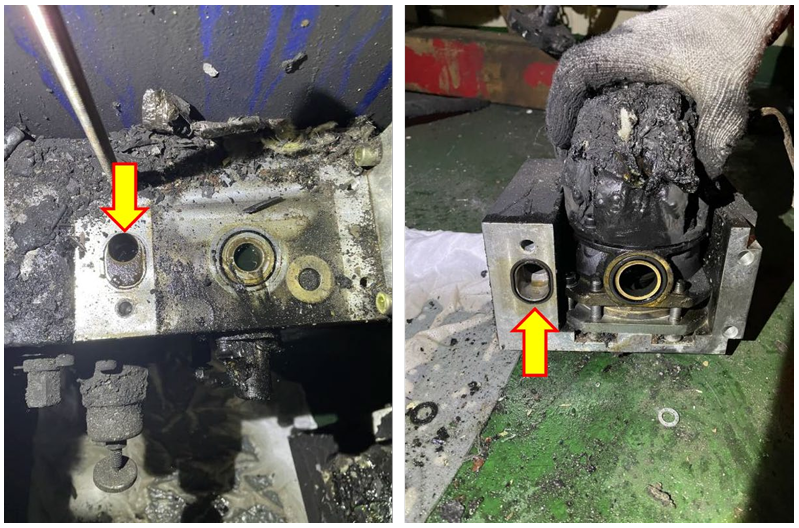
After the fire, the Lem Verbena operating company and Coast Guard investigators found that an O-ring on the oil fittings block upper module of the boiler’s burner unit had become pinched on the fuel port for the lower module. This O-ring was intended to provide a seal between the corresponding fuel ports on the lower and upper modules (when bolted together) to contain pressurized fuel as it moved through the system to the burner unit igniter.
Additionally, because of a software settings error discovered on the boiler unit’s SD card, the fuel pump did not shut down between cycles as intended and the pinched O-ring was exposed to constant pressure. The operating company found that the O-ring’s exposure to hot, pressurized fuel caused accelerated degradation of the O-ring, ultimately causing the seal to fail. Over time, the pinched portion of the O-ring was weakened until its seal failed under the fuel pressure in the ports. Because the fuel pump remained running even if the boiler burner was not firing and, therefore, the fuel system was always pressurized, pressurized fuel about 43 pounds per square inch would have atomized around the boiler and ignited on a nearby hot surface, causing the fire.
Findings
NTSB determined that the probable cause of the fire on the bulk carrier Lem Verbena was the failure of an O-ring seal on the composite boiler burner unit oil fittings block due to the radial misalignment of the two fuel ports on the block modules, causing pressurized diesel fuel to atomize and ignite on a nearby hot surface.
Read the full report: NTSB-MIR2608-Lem Verbena